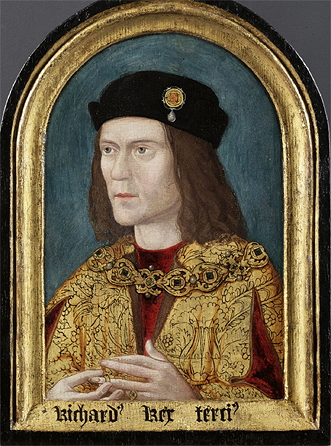
Richard III (2 October 1452 – 22 August 1485) was King of England from 1483 until his death in 1485, at the age of 32, in the Battle of Bosworth Field. He was the last king of the House of York and the last of the Plantagenet dynasty. His defeat at Bosworth Field, the last decisive battle of the Wars of the Roses, marked the end of the Middle Ages in England. He is the subject of thehistorical play Richard III by William Shakespeare.
When his brother King Edward IV died in April 1483, Richard was named Lord Protector of the realm for Edward's son and successor, the 12-year-old Edward V. As the young king travelled to London from Ludlow, Richard met and escorted him to lodgings in the Tower of London, where Edward V's own brother Richard of Shrewsbury joined him shortly afterwards. Arrangements were made for Edward's coronation on 22 June 1483; but, before the young king could be crowned, his father's marriage to his mother Elizabeth Woodvillewas declared invalid, making their children illegitimate and ineligible for the throne. On 25 June, an assembly of Lords and commoners endorsed the claims. The following day, Richard III began his reign, and he was crowned on 6 July 1483. The young princes were not seen in public after August, and accusations circulated that the boys had been murdered on Richard's orders, giving rise to the legend of the Princes in the Tower.
There were two major rebellions against Richard. The first, in October 1483, was led by staunch allies of Edward IV[1] and Richard's former ally, Henry Stafford, 2nd Duke of Buckingham;[2] but the revolt collapsed. In August 1485,Henry Tudor and his uncle, Jasper Tudor, led a second rebellion. Henry Tudor landed in southern Wales with a small contingent of French troops and marched through his birthplace, Pembrokeshire, recruiting soldiers. Henry's force engaged Richard's army and defeated it at the Battle of Bosworth Field inLeicestershire. Richard was struck down in the conflict, making him the last English king to die in battle on home soil and the first since Harold II was killed at the Battle of Hastings in 1066. Henry then ascended to the throne as Henry VII.
After the battle Richard's corpse was taken to Leicester and buried without pomp.[3] His original tomb monument is believed to have been removed during the Reformation, and his remains were lost for more than five centuries, believed to have been thrown into the River Soar.[4] In 2012, an archaeological excavation was commissioned by the Richard III Society on a city council car park on the site once occupied by Greyfriars Priory Church.[5][6] The University of Leicester identified the skeleton found in the excavation as that of Richard III as a result of radiocarbon dating, comparison with contemporary reports of his appearance, and comparison of his mitochondrial DNA with that of two matrilineal descendants of Richard III's eldest sister, Anne of York.[7][8][9]Richard's remains were reburied in Leicester Cathedral on 26 March 2015
Who was Richard III?
A Plantagenet primer on the last English king to die in battle.
Although he only ruled for two years – from 1483 to 1485 – Richard III stands out among his peers as one of the most famous (or infamous) Kings of England. But who was he? And why does he continue to inspire such interest?
Richard was born in Fotheringhay Castle, Northamptonshire on 2 October 1452 – about 30 miles (50km) from Leicester and only about 40 miles (65km - two days’ ride) from Bosworth where he met his end a third of a century later. Richard and his older brother Edward were the great-great-grandchildren of Edward III, a line of descent which was used to justify the claim to the throne by the House of York during the Wars of the Roses (the House of Lancaster was also descended from Edward III, via a different route).
The Princes in the Tower
The Princes in the Tower
The Two Princes Edward and Richard in the Tower, 1483 by Sir John Everett Millais, 1878.

Edward ruled as King Edward IV from 1461 until 1470 and again from 1471 until his death in 1483, when his 12-year-old son succeeded as Edward V, with Richard named Lord Protector. Young Edward and his brother moved into the Tower of London (which was then a royal palace, not a prison) but in June their parents’ marriage was declared invalid, making the princes illegitimate and hence their uncle became the heir apparent. Richard lost no time in being crowned King Richard III and the two boys were not seen again.
Thus began the legend of ‘the Princes in the Tower’ and a long-standing popular belief that Richard had his nephews murdered in order to remove any competing claim to the throne. This has been widely debated for many years, with passionate arguments made both for and against Richard.
Death and disappearance
After defeating an unsuccessful rebellion in October 1483, Richard led his army to Bosworth in Leicestershire two years later to face Henry Tudor (whose somewhat tenuous claim to the throne was also through descent from Edward III). On 22 August 1485, Richard was killed at Bosworth Field, the last English King to die in battle, thereby bringing to an end both the Plantagenet dynasty and the Wars of the Roses. Henry Tudor was crowned King Henry VII.
Richard’s body was brought back to Leicester, publicly displayed and then given for burial to a group of Franciscan friars. An alabaster tomb monument was constructed over the grave in 1495, paid for by the new King. With the dissolution of the monasteries (by Henry Tudor’s son, Henry VIII) that friary disappeared and along with it any clear record of Richard’s grave. Stories and rumours about where Richard’s mortal remains lie – or what happened to them – have circulated over the ensuing centuries, but most of these have subsequently been shown to be tall tales.

No comments:
Post a Comment