////////////////////////////////
Edward VI of England
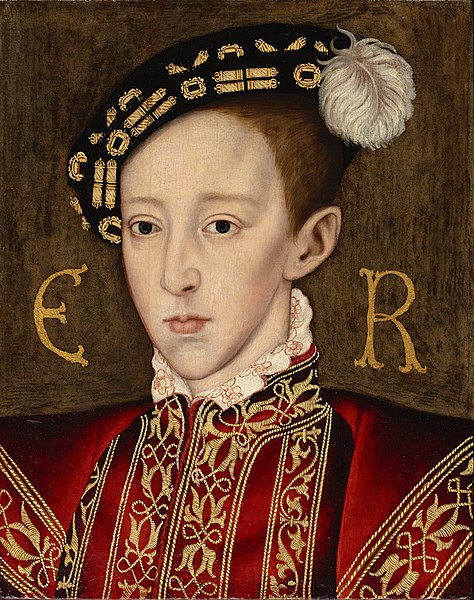
Edward VI (12 October 1537 – 6 July 1553) was King of England and Irelandfrom 28 January 1547 until his death. He was crowned on 20 February at the age of nine.[1] The son of Henry VIII and Jane Seymour, Edward was the third monarch of the Tudor dynasty and England's first monarch raised as a Protestant. During Edward's reign, the realm was governed by a Regency Council because he never reached his majority. The Council was first led by his uncle Edward Seymour, 1st Duke of Somerset (1547–1549), and then byJohn Dudley, 1st Earl of Warwick, from 1551 Duke of Northumberland.
Edward's reign was marked by economic problems and social unrest that, in 1549, erupted into riot and rebellion. An expensive war with Scotland, at first successful, ended with military withdrawal from Scotland as well as Boulogne-sur-Mer in exchange for peace. The transformation of the Church into a recognisably Protestant body also occurred under Edward, who took great interest in religious matters. Although his father, Henry VIII, had severed the link between the Church of England and Rome, Henry VIII had never permitted the renunciation of Catholic doctrine or ceremony. It was during Edward's reign that Protestantism was established for the first time in England with reforms that included the abolition of clerical celibacy and the Mass and the imposition of compulsory services in English. The architect of these reforms was Thomas Cranmer, Archbishop of Canterbury, whose Book of Common Prayer is still used.
In February 1553, at age 15, Edward fell ill. When his sickness was discovered to be terminal, he and his Council drew up a "Devise for the Succession", attempting to prevent the country's return to Catholicism. Edward named his first cousin once removed, Lady Jane Grey, as his heir and excluded his half-sisters, Mary and Elizabeth. However, this decision was disputed following Edward's death, and Jane was deposed by Mary within 13 days. As queen, Mary reversed Edward's Protestant reforms, which nonetheless became the basis of the Elizabethan Religious Settlement of 1559.
Birth[edit]
Edward was born on 12 October 1537 in his mother's room inside Hampton Court Palace, in Middlesex.[3] He was the son of King Henry VIII by his third wife, Jane Seymour. Throughout the realm, the people greeted the birth of a male heir, "whom we hungered for so long",[4] with joy and relief. Te Deums were sung in churches, bonfires lit, and "their was shott at the Tower that night above two thousand gonnes".[5] Queen Jane, appearing to recover quickly from the birth, sent out personally signed letters announcing the birth of "a Prince, conceived in most lawful matrimony between my Lord the King's Majesty and us". Edward was christened on 15 October, with his half-sisters, the 21-year-old Lady Mary as godmother and the 4-year-old Lady Elizabeth carrying the chrisom;[5] and the Garter King of Armsproclaimed him as Duke of Cornwall and Earl of Chester.[6] The Queen, however, fell ill on 23 October from presumed postnatal complications, and died the following night. Henry VIII wrote to Francis I of France that "Divine Providence ... hath mingled my joy with bitterness of the death of her who brought me this happiness"
Upbringing and education[edit]

Edward was a healthy baby who suckled strongly from the outset. His father was delighted with him; in May 1538, Henry was observed "dallying with him in his arms ... and so holding him in a window to the sight and great comfort of the people".[9] That September, the Lord Chancellor, Thomas, Lord Audley, reported Edward's rapid growth and vigour;[9] and other accounts describe him as a tall and merry child. The tradition that Edward VI was a sickly boy has been challenged by more recent historians.[10] At the age of four, he fell ill with a life-threatening "quartan fever",[11] but, despite occasional illnesses and poor eyesight, he enjoyed generally good health until the last six months of his life.[12]
Edward was initially placed in the care of Margaret Bryan, "lady mistress" of the prince's household. She was succeeded by Blanche Herbert, Lady Troy. Until the age of six, Edward was brought up, as he put it later in his Chronicle, "among the women".[13] The formal royal household established around Edward was, at first, under Sir William Sidney, and later Sir Richard Page, stepfather of Edward Seymour's wife, Anne Stanhope. Henry demanded exacting standards of security and cleanliness in his son's household, stressing that Edward was "this whole realm's most precious jewel".[14] Visitors described the prince, who was lavishly provided with toys and comforts, including his own troupe of minstrels, as a contented child.[15]
From the age of six, Edward began his formal education under Richard Cox and John Cheke, concentrating, as he recalled himself, on "learning of tongues, of the scripture, of philosophy, and all liberal sciences";[16] He received tuition from Elizabeth's tutor, Roger Ascham, and Jean Belmain, learning French, Spanish and Italian. In addition, he is known to have studied geometry and learned to play musical instruments, including the lute and the virginals. He collected globes and maps and, according to coinage historian C. E. Challis, developed a grasp of monetary affairs that indicated a high intelligence. Edward's religious education is assumed to have favoured the reforming agenda.[17] His religious establishment was probably chosen by Archbishop Thomas Cranmer, a leading reformer. Both Cox and Cheke were "reformed" Catholics or Erasmians and later became Marian exiles. By 1549, Edward had written a treatise on the pope as Antichrist and was making informed notes on theological controversies.[18] Many aspects of Edward's religion were essentially Catholic in his early years, including celebration of the mass and reverence for images and relics of the saints.[19]

Both Edward's sisters were attentive to their brother and often visited him – on one occasion, Elizabeth gave him a shirt "of her own working".[20] Edward "took special content" in Mary's company, though he disapproved of her taste for foreign dances; "I love you most", he wrote to her in 1546.[21] In 1543, Henry invited his children to spend Christmas with him, signalling his reconciliation with his daughters, whom he had previously illegitimised and disinherited. The following spring, he restored them to their place in the succession with a Third Succession Act, which also provided for a regency council during Edward's minority.[22] This unaccustomed family harmony may have owed much to the influence of Henry's new wife Catherine Parr,[23] of whom Edward soon became fond. He called her his "most dear mother" and in September 1546, wrote to her: "I received so many benefits from you that my mind can hardly grasp them."[24]
Other children were brought to play with Edward, including the granddaughter of Edward's chamberlain, Sir William Sidney, who in adulthood recalled the prince as "a marvellous sweet child, of very mild and generous condition".[25] Edward was educated with sons of nobles, "appointed to attend upon him" in what was a form of miniature court. Among these, Barnaby Fitzpatrick, son of an Irish peer, became a close and lasting friend.[26] Edward was more devoted to his schoolwork than his classmates and seems to have outshone them, motivated to do his "duty" and compete with his sister Elizabeth's academic prowess. Edward's surroundings and possessions were regally splendid: his rooms were hung with costly Flemish tapestries, and his clothes, books, and cutlery were encrusted with precious jewels and gold.[27] Like his father, Edward was fascinated by military arts, and many of his portraits show him wearing a gold dagger with a jewelled hilt, in imitation of Henry.[28] Edward's Chronicle enthusiastically details English military campaigns against Scotland and France, and adventures such as John Dudley's near capture at Musselburgh in 1547

No comments:
Post a Comment