//////////////////////////////////////////
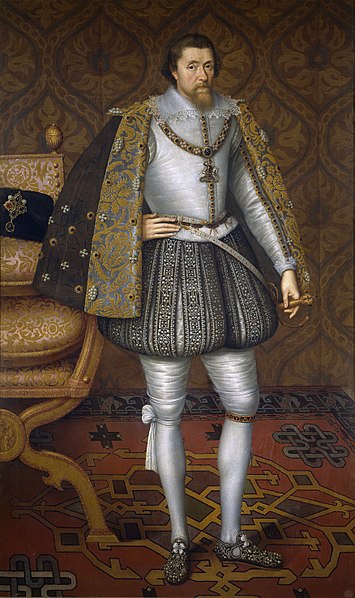
James VI and I (19 June 1566 – 27 March 1625) was King of Scotland asJames VI from 24 July 1567 and King of England and Ireland as James I from the union of the Scottish and English crowns on 24 March 1603 until his death. The kingdoms of Scotland and England were individual sovereign states, with their own parliaments, judiciary, and laws, though both were ruled by James inpersonal union.
James was the son of Mary, Queen of Scots, and a great-great-grandson ofHenry VII, King of England and Lord of Ireland (through both his parents), uniquely positioning him to eventually accede to all three thrones. James succeeded to the Scottish throne at the age of thirteen months, after his mother Mary was compelled to abdicate in his favour. Four different regentsgoverned during his minority, which ended officially in 1578, though he did not gain full control of his government until 1583. In 1603, he succeeded the lastTudor monarch of England and Ireland, Elizabeth I, who died without issue.[a]He continued to reign in all three kingdoms for 22 years, a period known as theJacobean era after him, until his death in 1625 at the age of 58. After the Union of the Crowns, he based himself in England (the largest of the three realms) from 1603, only returning to Scotland once in 1617, and styled himself "King of Great Britain and Ireland".[b] He was a major advocate of a single parliament for England and Scotland. In his reign, the Plantation of Ulster and British colonisation of the Americas began.
At 57 years and 246 days, James's reign in Scotland was longer than those of any of his predecessors. He achieved most of his aims in Scotland but faced great difficulties in England, including the Gunpowder Plot in 1605 and repeated conflicts with the English Parliament. Under James, the "Golden Age" of Elizabethan literature and drama continued, with writers such as William Shakespeare, John Donne, Ben Jonson, and Sir Francis Bacon contributing to a flourishing literary culture.[1] James himself was a talented scholar, the author of works such as Daemonologie (1597), The True Law of Free Monarchies(1598), and Basilikon Doron (1599). He sponsored the translation of the Bible that was named after him: the Authorised King James Version.[c] Sir Anthony Weldon claimed that James had been termed "the wisest fool in Christendom", an epithet associated with his character ever since.[d] Since the latter half of the 20th century, historians have tended to revise James's reputation and treat him as a serious and thoughtful monarch
James was the only son of Mary, Queen of Scots, and her second husband, Henry Stuart, Lord Darnley. Both Mary and Darnley were great-grandchildren of Henry VII of Englandthrough Margaret Tudor, the older sister of Henry VIII. Mary's rule over Scotland was insecure, and she and her husband, being Roman Catholics, faced a rebellion by Protestantnoblemen. During Mary's and Darnley's difficult marriage,[2] Darnley secretly allied himself with the rebels and conspired in the murder of the Queen's private secretary, David Rizzio, just three months before James's birth.[3]
James was born on 19 June 1566 at Edinburgh Castle, and as the eldest son and heir apparent of the monarch automatically became Duke of Rothesay and Prince and Great Steward of Scotland. He was baptised "Charles James" or "James Charles" on 17 December 1566 in a Catholic ceremony held at Stirling Castle. His godparents were Charles IX of France (represented by John, Count of Brienne), Elizabeth I of England (represented by theEarl of Bedford), and Emmanuel Philibert, Duke of Savoy (represented by ambassador Philibert du Croc).[4] Mary refused to let the Archbishop of St Andrews, whom she referred to as "a pocky priest", spit in the child's mouth, as was then the custom.[5] The subsequent entertainment, devised by Frenchman Bastian Pagez, featured men dressed as satyrs and sporting tails; the English guests took offence, thinking the satyrs "done against them".[6]
James's father, Darnley, was murdered on 10 February 1567 at Kirk o' Field, Edinburgh, perhaps in revenge for Rizzio's death. James inherited his father's titles of Duke of Albany and Earl of Ross. Mary was already unpopular, and her marriage on 15 May 1567 to James Hepburn, 4th Earl of Bothwell, who was widely suspected of murdering Darnley, heightened widespread bad feeling towards her.[f] In June 1567, Protestant rebels arrested Mary and imprisoned her in Loch Leven Castle; she never saw her son again. She was forced to abdicate on 24 July 1567 in favour of the infant James and to appoint her illegitimate half-brother, James Stewart, Earl of Moray, as regent
The care of James was entrusted to the Earl and Countess of Mar, "to be conserved, nursed, and upbrought"[g] in the security of Stirling Castle.[8] James was crowned King of Scots at the age of thirteen months at the Church of the Holy Rude, Stirling, by Adam Bothwell, Bishop of Orkney, on 29 July 1567.[9] The sermon at thecoronation was preached by John Knox. In accordance with the religious beliefs of most of the Scottish ruling class, James was brought up as a member of the Protestant Church of Scotland. The Privy Council selected George Buchanan, Peter Young, Adam Erskine (lay abbot of Cambuskenneth), and David Erskine (lay abbot of Dryburgh) as James's preceptors or tutors.[10] As the young king's senior tutor, Buchanan subjected James to regular beatings but also instilled in him a lifelong passion for literature and learning.[11] Buchanan sought to turn James into a God-fearing, Protestant king who accepted the limitations of monarchy, as outlined in histreatise De Jure Regni apud Scotos.[12]
In 1568, Mary escaped from her imprisonment at Loch Leven Castle, leading to several years of sporadic violence. The Earl of Moray defeated Mary's troops at the Battle of Langside, forcing her to flee to England, where she was subsequently imprisoned by Elizabeth. On 23 January 1570, Moray was assassinated by James Hamilton of Bothwellhaugh.[13] The next regent was James's paternal grandfather Matthew Stewart, 4th Earl of Lennox, who was carried fatally wounded into Stirling Castle a year later after a raid by Mary's supporters.[14] His successor, the Earl of Mar, "took a vehement sickness" and died on 28 October 1572 at Stirling. Mar's illness, wrote James Melville, followed a banquet at Dalkeith Palace given by James Douglas, 4th Earl of Morton.[15]
Morton was elected to Mar's office and proved in many ways the most effective of James's regents,[16] but he made enemies by his rapacity.[17] He fell from favour when Frenchman Esmé Stewart, Sieur d'Aubigny, first cousin of James's father Lord Darnley and future Earl of Lennox, arrived in Scotland and quickly established himself as the first of James's powerful male favourites.[18] Morton was executed on 2 June 1581, belatedly charged with complicity in Lord Darnley's murder.[19] On 8 August, James made Lennox the only duke in Scotland.[20] The king, then fifteen years old, remained under the influence of Lennox for about one more year.[21]
Rule in Scotland[edit]

Lennox was a Protestant convert, but he was distrusted by Scottish Calvinists who noticed the physical displays of affection between him and the king and alleged that Lennox "went about to draw the King to carnal lust".[17] In August 1582, in what became known as theRuthven Raid, the Protestant earls of Gowrie and Angus lured James into Ruthven Castle, imprisoned him,[22] and forced Lennox to leave Scotland. During his imprisonment, John Craig, whom James had personally appointed Royal Chaplain in 1579, rebuked him so sharply from the pulpit (19 September 1582) for having issued a proclamation offensive to the clergy "that the king wept".[23]
After James was liberated in June 1583, he assumed increasing control of his kingdom. He pushed through the Black Acts to assert royal authority over the Kirk, and denounced the writings of his former tutor Buchanan.[24] Between 1584 and 1603, he established effective royal government and relative peace among the lords, ably assisted by John Maitland of Thirlestane who led the government until 1592.[25] An eight-man commission known as theOctavians brought some control over the ruinous state of James's finances in 1596, but it drew opposition from vested interests. It was disbanded within a year after a riot in Edinburgh that was stoked by anti-Catholicism led the court to withdraw to Linlithgow temporarily.[26]
One last Scottish attempt against the king's person occurred in August 1600, when James was apparently assaulted byAlexander Ruthven, the Earl of Gowrie's younger brother, at Gowrie House, the seat of the Ruthvens.[27] Ruthven was run through by James's page John Ramsay and the Earl of Gowrie was himself killed in the ensuing fracas; there were few surviving witnesses. James's account of the circumstances was not universally believed, given his history with the Ruthvens and the fact that he owed them a great deal of money.[28]
In 1586, James signed the Treaty of Berwick with England. That and the execution of his mother in 1587, which he denounced as a "preposterous and strange procedure", helped clear the way for his succession south of the border.[29]Queen Elizabeth was unmarried and childless, and James was her most likely successor. Securing the English succession became a cornerstone of his policy.[30] During the Spanish Armada crisis of 1588, he assured Elizabeth of his support as "your natural son and compatriot of your country".[31]
Marriage[edit]

Throughout his youth, James was praised for his chastity, since he showed little interest in women. After the loss of Lennox, he continued to prefer male company.[32]A suitable marriage, however, was necessary to reinforce his monarchy, and the choice fell on fourteen-year-old Anne of Denmark, younger daughter of ProtestantFrederick II. Shortly after a proxy marriage in Copenhagen in August 1589, Anne sailed for Scotland but was forced by storms to the coast of Norway. James sailed from Leith on hearing that the crossing had been abandoned, in what Willson calls "the one romantic episode of his life",[33] with a 300-strong retinue to fetch Anne personally.[34] The couple were married formally at the Bishop's Palace in Oslo on 23 November and returned to Scotland on 1 May 1590, after stays at Elsinore andCopenhagen and a meeting with Tycho Brahe. By all accounts, James was at first infatuated with Anne and, in the early years of their marriage, seems always to have showed her patience and affection.[35] The royal couple produced three children who survived to adulthood: Henry Frederick, Prince of Wales, who died of typhoid fever in 1612, aged 18; Elizabeth, later queen of Bohemia; and Charles, his successor. Anne died before her husband in March 1619.

No comments:
Post a Comment